The end-of-semester student evaluation forms are known as Student Perception of Instruction (SPI or SPoI) forms at UCF.
SPI Questions
Instructors of Record are evaluated once per semester by their students. Information about the timing of these evaluations can be found in the “SPI Process” section below. These are the statements students respond to:
- The course expectations were clear.
- The course was well organized.
- Graded work was aligned with course content.
- The instructor made clear efforts to engage students.
- The instructor was helpful in responding to questions.
- I received sufficient feedback on my performance in the class.
- The instructor was available for assistance.
- The instructor enhanced my understanding of the material.
Students are given a Likert Scale of responses that are scored numerically: Strongly Agree (5), Agree (4), Neutral (3), Disagree (2), Strongly Disagree (1).
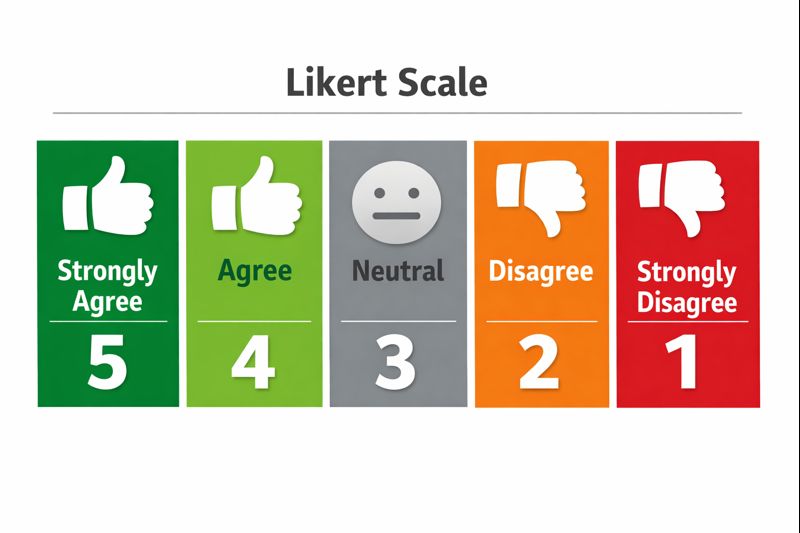
Image generated by ChatGPT on January 9, 2026
Additionally, there are two nonstudent-facing averages for overall effectiveness that are calculated based on the responses to the student-facing questions above:
- Overall Effectiveness of the course and its content (a composite for questions 1-3).
- Overall Effectiveness of the instructor and the instruction (a composite for questions 4-8).
In addition to rating the instructor using the Likert Scale, students are given two open-ended questions students to answer, if they choose:
- Describe to the instructor the most effective elements of the course and its instruction.
- Explain to the instructor your suggestions for improving the course and its instruction.
SPI Process
- Two weeks before the final scheduled day of class in a given semester, SPIs open to students. The SPI window closes at the end of the last day, just before the Final Exam period.
- Faculty will be notified by email that the SPIs are available.
- Students will see a popup each time they log in to the Student Center section of myUCF during the open SPI window. If they complete the SPIs for all their classes, this popup will no longer appear.
- After semester grades are due, SPI results are released to department chairs and individual faculty, who will be notified by email. The results include SPI averages for the department, the college, and across UCF.
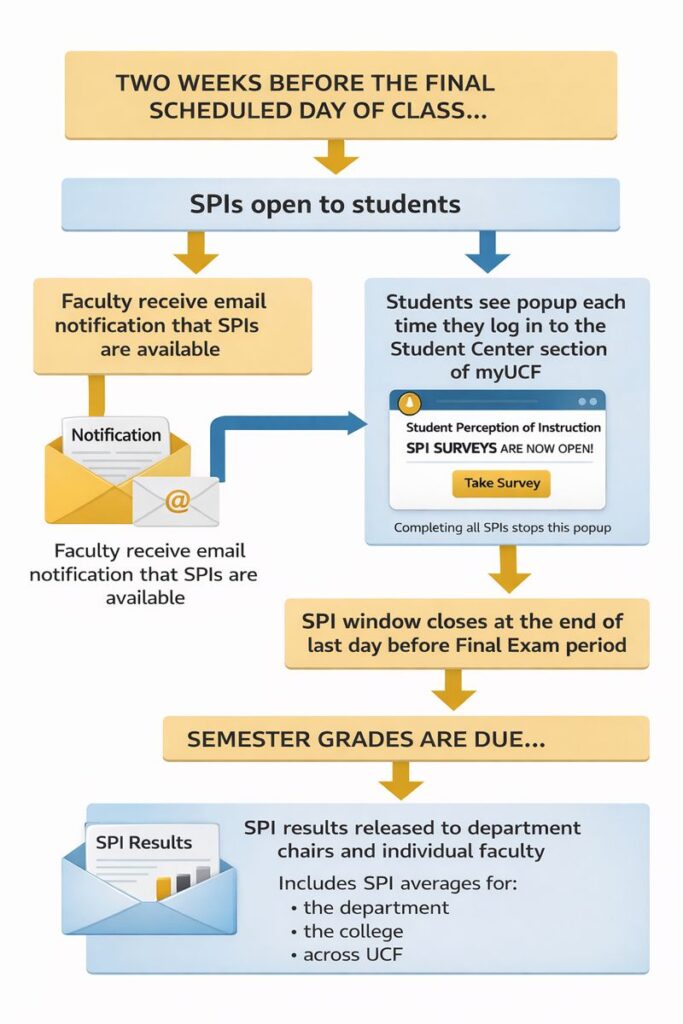
Image generated by ChatGPT on January 9, 2026.
Faculty are strongly encouraged to adopt a mindset of continuous improvement with regard to their teaching in the face of SPI reports. Student feedback about your teaching is an important consideration.
- Pay attention to trends in the SPI results over multiple semesters, whether all the numbers move in lockstep or there are particular outliers. These might suggest areas where you could try different approaches in future teaching.
- Student comments to the free-response questions can be particularly revealing. The Likert-scale questions are sometimes completed by students in a “straight line” fashion (all questions get the same response), but free-response answers require more student thought and thus warrant attention.
Ideas for Improving SPI Results
Here are some ideas for improving SPI results:
- Consider soliciting feedback from students much earlier in the semester, while there is still time to make changes in the current term. You could use this midterm feedback form or create your own.
- Be transparent about why you are asking students for their feedback. Explaining to them that their feedback is valuable and that it can help shape their learning experience can be motivating for students.
- Vary your teaching methods to make the content more understandable and engaging for the most students possible. The Faculty Center is open from 8 AM – 5 PM Monday through Friday if you want to brainstorm ideas!
- Build relevance by connecting a single lesson to the bigger picture.
- How does the content in one lesson build on what they have already studied and how will it contribute to their readiness for future lessons or courses?
- How does what you have students do in class connect to the course and/or program learning objectives?
- Encourage questions. Assure students that they are not the first students to find a topic difficult and that you will do your best to answer their questions.
- It may be helpful to remind students that you cannot answer a question if you don’t know it exists in their minds.
- Send students a weekly “recap” email that reminds students of what they learned during the week and the assignments that they completed and that they will have during the next week. Remind students that you are here to help them learn and remind them of the best ways of communicating with you (via email, during office hours, etc.).

Creative Commons Image from Tempesta Media: Digital Marketing Solutions
Faculty are encouraged to connect with the Faculty Center to request individualized, private consultations or perhaps arrange for a peer observation. The Faculty Center is open from 8 AM – 5 PM Monday through Friday, and services are provided to faculty free of charge.
Ideas for Increasing Student Completion Rates
Some students may not see the system-generated reminder to complete SPIs if they don’t otherwise have a reason to visit the Student Center during the SPI window. While the Student Center is where they register for classes in future terms, their registration window may not match the SPI window. Thus, instructors may wish to adopt strategies that encourage students to complete the SPIs:
- Send out a specific announcement about the SPI availability through Webcourses
- Announce the SPI availability in face-to-face classes.
- Remind students that their responses are anonymous.
- Clarify who receives the responses and what the procedures are for faculty to get the SPI data.
- Persuade students that their SPI input truly matters:
- You, the instructor, value their comments and want to continuously improve your teaching.
- Their comments and ideas can influence future versions of this class and make a difference for future students.
- Relate examples of past student suggestions that are now part of your teaching.
- Set aside time in face-to-face classes for students to complete the SPI using their own devices. Faculty are strongly encouraged to exit the room during the allotted time to ensure response anonymity.
- Show appreciation for student responses, even if you aren’t sure that anyone has completed the SPI for your course.

Faculty who are interested in exploring the research about how to improve response rates can access these resources:
- Chapman, D. D. & Joines, J. A. (2017). Strategies for increasing response rates for online end-of-course evaluations. International Journal of Teaching and Learning in Higher Education, 29(1), 47–60. https://files.eric.ed.gov/fulltext/EJ1136018.pdf
- Cone, C., Viswesh, V., Gupta, V., & Unni, E. (2018). Motivators, barriers, and strategies to improve response rate to student evaluation of teaching. Currents in Pharmacy Teaching and Learning. https://doi.org/10.1016/J.CPTL.2018.08.020
- Crews, T. B. & Curtis, D. F. (2011). Online course evaluations: Faculty perspective and strategies for improved response rates. Assessment & Evaluation in Higher Education, 36(7), 865–878. https://doi.org/10.1080/02602938.2010.493970
- Medina, M. S., Smith, W., Kolluru, S., Sheaffer, E. A., & DiVall, M. V. (2019). A review of strategies for designing, administering, and using student ratings of instruction. American Journal of Pharmaceutical Education, 83(5), Article 7177. https://doi.org/10.5688/AJPE7177
- Nair, C. S., Adams, P., & Mertova, P. (2008). Student engagement: The key to improving survey response rates. Quality in Higher Education, 14(3), 225–232. https://doi.org/10.1080/13538320802507505
- Young, K. R., Joines, J. A., Standish, T., & Gallagher, V. J. (2019). Student evaluations of teaching: The impact of faculty procedures on response rates. Assessment & Evaluation in Higher Education, 44(1), 37–49. https://doi.org/10.1080/02602938.2018.1467878
Frequently Asked Questions
- Can I see how many of my students completed the SPI?
- Yes. In myUCF, click on Faculty Self-Service, then Instructors, then SPI Counts.
- Can I find out which individual students completed the SPI so that I can award extra credit?
- No. Keeping students anonymous is central to the integrity of the process. It will also not work to ask students to generate a screencap of their finished process, due to the same need for anonymity (plus, one student could make such a screencap and share it with all other students). It is better to avoid any extra credit in the SPI process.
- Will independent study courses complete the SPI?
- No. Internships, thesis, independent study, non-graded labs, practicum, dissertation and research hours do not require students to complete an SPI.
- Why did I not receive SPI results for one of my classes?
- Data for courses with fewer than five students enrolled is intentionally excluded from the results and will not be released.
- Where can I get more information?
- The Student Perception of Instruction process is governed by the Faculty Senate and the Faculty Excellence office. All requests for access to SPI results, for current or previous semesters, and any questions regarding missing course data or other errors should be directed to the Faculty Excellence office at FacultyExcellence@ucf.edu